Last Tuesday morning, a parent opened Life360 to check whether their teenager had made it to school. They had. The app logged it.
That data point, the teenager's location, the time, the routine, now belongs to a company that also owns a native advertising network reaching 600 million monthly unique visitors.
Life360's acquisition of Nativo isn't a privacy story, exactly. It's something more structurally interesting: a company that built a subscription business on family safety just revealed that its second business is advertising, and it has been building the infrastructure for it quietly.
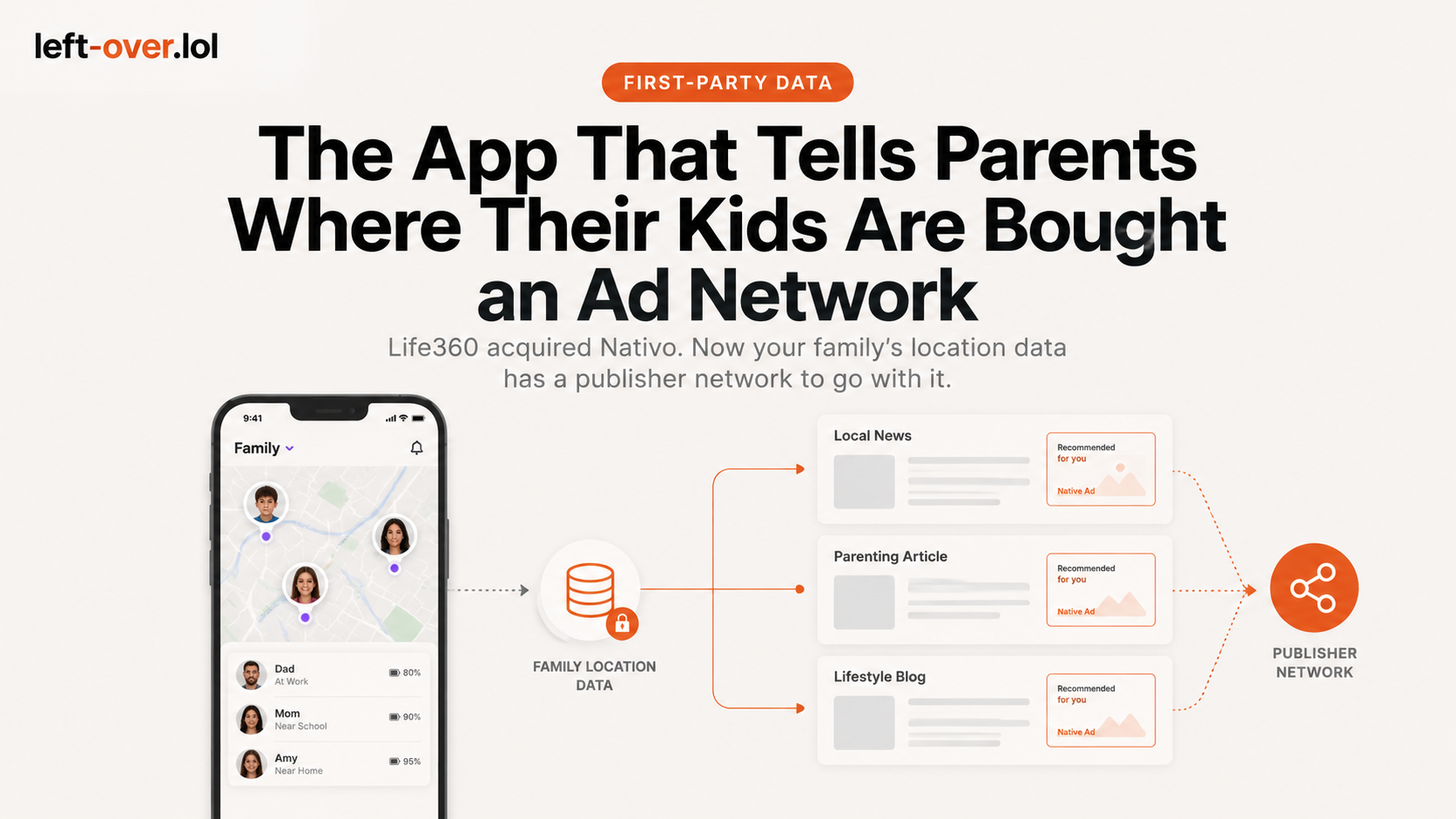
Here's what the deal actually assembles. Life360 has 66 million monthly active users who have opted in to share their location with family members. That creates a first-party data asset most advertisers would spend years trying to build, real household graphs, real movement patterns, real life-stage signals. Is this household preparing for back-to-school? Did someone in this family just start commuting to a new zip code? Life360 knows.
Nativo brings the distribution layer. Its native ad platform integrates directly into publisher content feeds, which means Life360's audience insights don't have to go through a third-party DSP to reach premium inventory. The company acquires the match between its data and the media supply chain.
The combination isn't subtle. Life360 said the deal expands its advertising platform by pairing its first-party family and location insights with Nativo's publisher network. That is a clean description of what a data-plus-distribution ad business looks like.
What it doesn't address is consent architecture. Life360 users agreed to share location data with their family members. They did not agree to be modeled into ad targeting segments, at least not in the way most of them understand the word 'agree.' The company's privacy policy is broad enough to permit the use. That's different from saying users understand it.
None of this is illegal. Most of it isn't even unusual by ad tech standards. But Life360 is not an ad tech company in the minds of its users, it's the app they installed when their kid got a phone. That gap between how users perceive a product and how that product actually monetizes them is the oldest story in this industry.
The more interesting question isn't whether Life360 will use location data for advertising. It's whether parents who trusted the app with their children's location will notice when they do.
They probably won't. That's the business model.