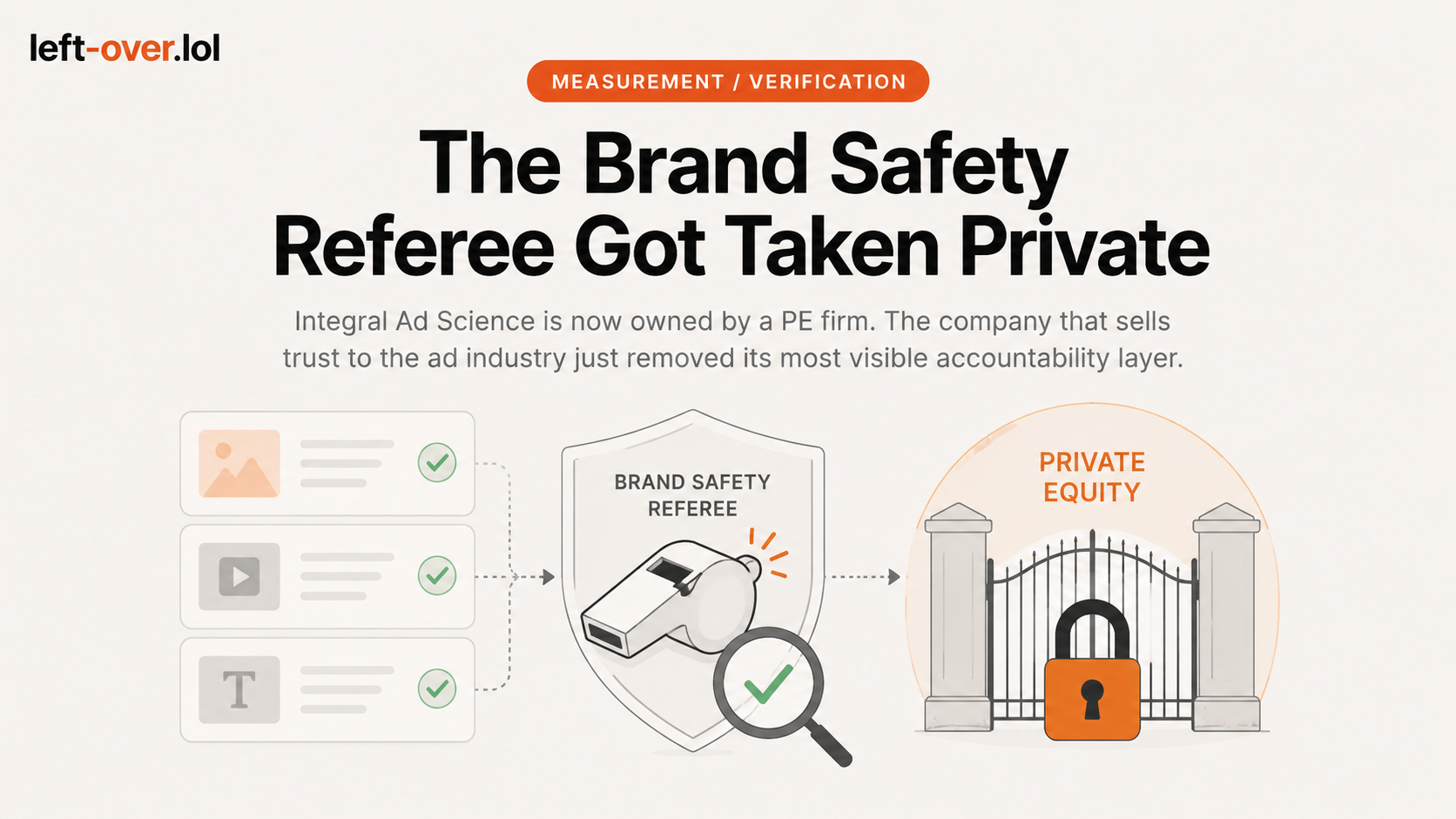
Brand safety is a product sold on trust. Advertisers pay IAS, DoubleVerify, and MOAT to verify that their ads ran in the environments they were promised, next to legitimate content, seen by real humans, in brand-appropriate contexts. The verification layer is, in theory, independent of the platforms it's auditing.
Novacap just acquired IAS for approximately $1.9 billion and took it private.
The governance question this raises is not complicated: public companies file quarterly reports. They disclose material business risks. Their methodologies are subject to the scrutiny that comes with being publicly accountable. Private companies do not have the same obligations.
IAS sells independence. It sells the assurance that someone is checking the work of the platforms and publishers that ads run on. That product is only valuable if the checker is credible. Credibility has historically been linked, in this industry, to transparency.
None of this means Novacap will compromise IAS's methodology. PE ownership of verification companies is not new, The Trade Desk has invested in measurement companies, large holding companies have stakes in verification tools. Conflicts of interest in ad tech measurement are structural and long-standing.
But there is a difference between conflicts that are disclosed in public filings and conflicts that are managed privately. The former allows the market to price the risk. The latter asks the market to trust the acquirer's judgment.
Three agency planning directors contacted for this piece declined to comment on the record. Two said, separately, that they were 'watching the transition closely.' One said, 'the product works until it doesn't, and we won't know until it doesn't.'
That last quote is either a sophisticated risk assessment or a description of how brand safety theater functions. Probably both.
The deeper structural issue is that the ad industry has never resolved its measurement independence problem. The platforms measure themselves. The verification companies audit the platforms. The holding companies own stakes in the verification companies. Everyone is watching everyone else, and nobody is outside the system.
Taking IAS private makes that system slightly less visible. Which is exactly the wrong direction.