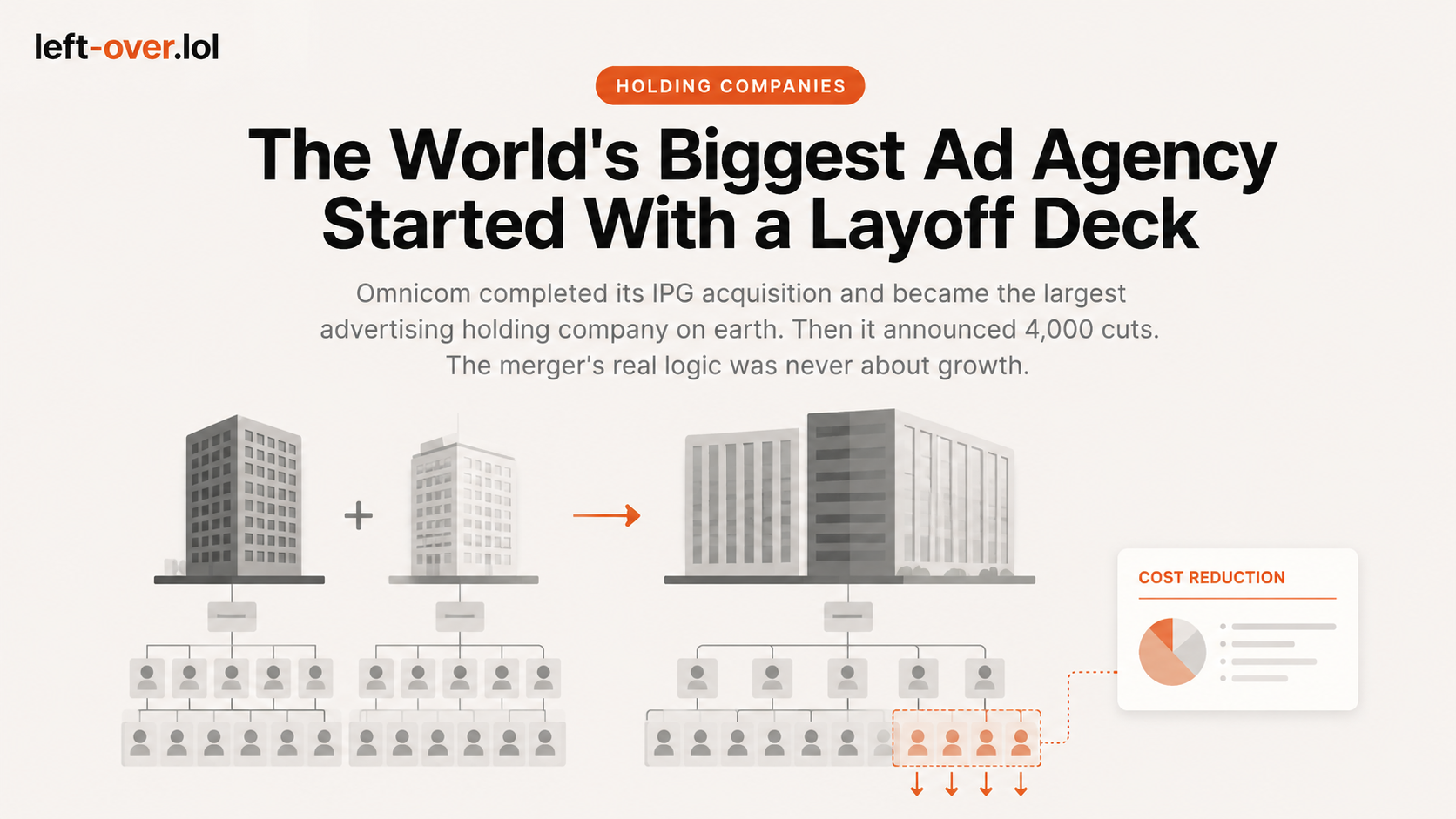
When Omnicom announced it was acquiring IPG in late 2025, the press releases used the language of ambition. Scale. Capabilities. The combined entity would be the world's largest advertising holding company, a global force in marketing services, a platform for the AI-powered future of creative and media.
Then came the layoff deck. Four thousand positions cut. Agency brands consolidated. Back-office functions merged. The combination that was sold as expansion is being executed as contraction.
This is not a scandal. It is the actual logic of holding company mergers, stated plainly.
The agency holding company model was built for a world of steadily increasing ad spend, client growth, and geographic expansion. For decades, WPP, Publicis, Omnicom, and IPG grew by acquiring independent agencies, keeping the brands, and extracting back-office efficiencies. The model worked because the category grew.
The category is no longer growing the same way. Consulting firms, Accenture Song, Deloitte Digital, have eaten into creative strategy. In-house agencies have absorbed work that would have gone to holding companies. AI tools have begun compressing production costs in ways that reduce the billable hour. The revenue per employee that made holding company multiples work is under pressure from multiple directions simultaneously.
Merging Omnicom and IPG doesn't solve those structural problems. It reduces the overhead load while the company figures out how to solve them. Two finance teams become one. Two procurement functions merge. Agency brands with overlapping client conflicts get consolidated. The savings are real; the growth strategy remains to be demonstrated.
Sources inside both networks described the integration as 'faster than expected and more disruptive than announced.' One senior creative director at a legacy IPG shop described receiving a Slack message informing her team that their agency name would be retired within the fiscal year. 'Nobody called,' she said. 'It was a Slack message.'
A Publicis executive, reached separately, declined to comment but laughed.
The 4,000 number is the honest accounting of what this merger is actually for. The combined entity needed to remove cost, not add capability. The capability story will come later, or it won't, and this will be remembered as the moment the holding company model started its managed decline.
For now: the world's largest ad agency exists. It is also, by headcount, smaller than it was last year.