For decades, sports rights were simple enough to explain at a steakhouse.
A network paid the league. Advertisers paid the network. Cable distributors paid affiliate fees. Everyone complained. Everyone renewed.
That model is still technically alive, in the same way a mall with three open stores is technically alive.
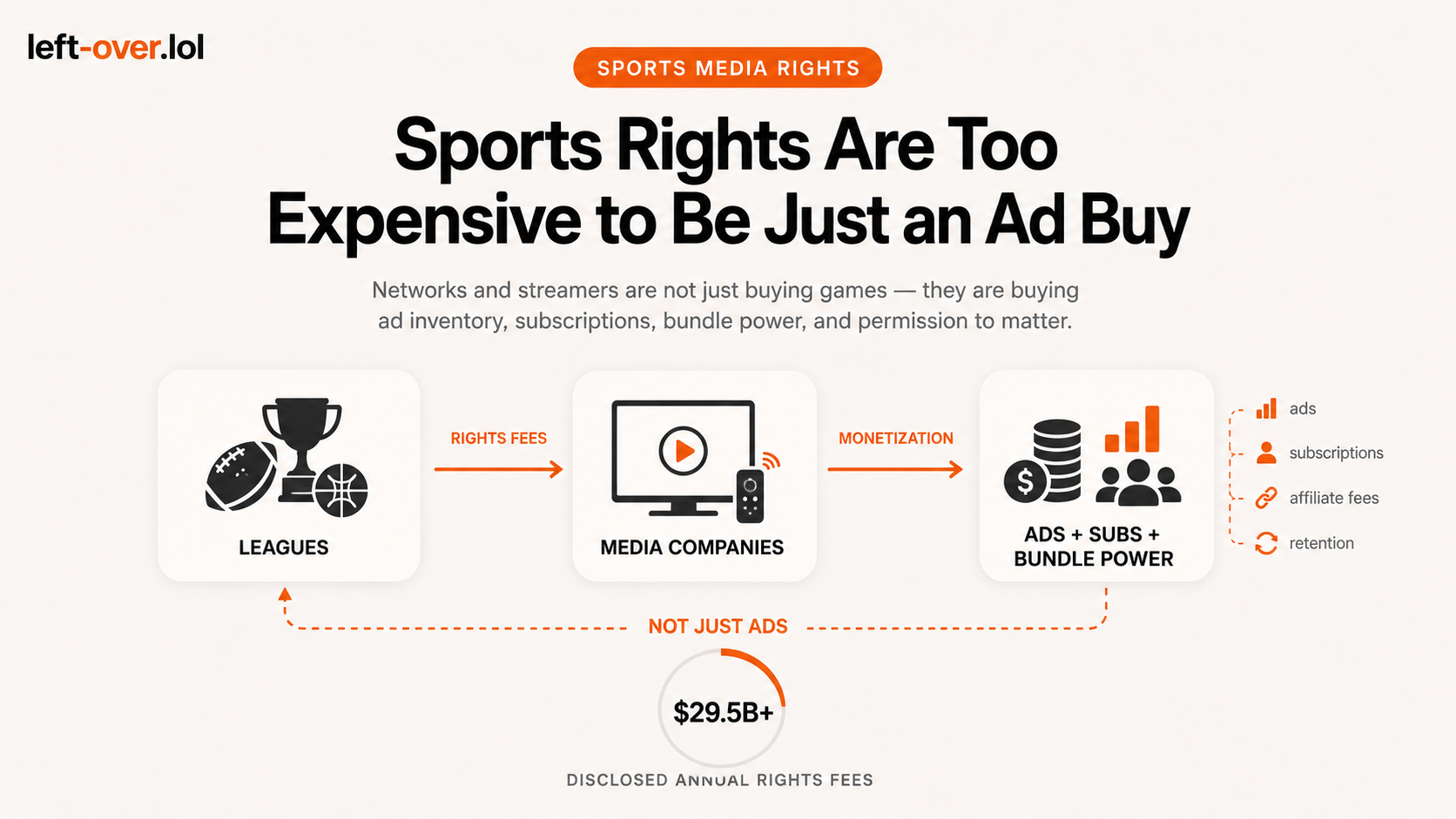
Today, sports rights are not just programming costs. They are bundle defense, streaming bait, ad-tech inventory, churn medication, affiliate-fee leverage, retail-media packaging, and executive ego insurance. Sometimes all at once. Occasionally before lunch.
The annual checks are enormous.
Disney is carrying roughly $9.5 billion a year in disclosed sports rights across the NFL, NBA, College Football Playoff, SEC, MLB, NHL, WWE, ACC, and more. Comcast/NBCU is sitting near $5.9 billion when you add the NFL, NBA, Olympics, Premier League, MLB, and golf. Paramount/CBS is around $3.5 billion with the NFL, NCAA tournament, and UFC. Fox has about $3 billion tied up in the NFL and MLB before even getting into every shared package that is harder to split cleanly.
Then the tech companies walk in wearing sneakers.
Amazon has about $2.8 billion a year committed to the NFL and NBA. YouTube is paying about $2 billion a year for Sunday Ticket. Netflix is building a roughly $700 million live-sports lane through WWE, NFL Christmas, and MLB specials. Apple is nibbling around the edges with MLS, MLB, and F1, which for Apple is less a cost center and more a rounding error wearing a racing jacket.
The same dollar buys very different stress depending on who is writing the check.
For Amazon, $2.8 billion is a large sports-rights bill and a small corporate thought. Amazon generated about $716.9 billion in 2025 net sales and $68.6 billion from advertising services. Its NFL and NBA spend is roughly 4 percent of ad revenue, less than half a percent of total company sales. That is not a bet-the-company move. That is a customer-acquisition expense with shoulder pads.
For YouTube, Sunday Ticket looks expensive until you remember YouTube did more than $60 billion across ads and subscriptions in 2025. A $2 billion NFL package is painful, sure, but it is also a retention tool for YouTube TV, a subscription upsell, and a way to make YouTube look less like a video site and more like the future cable bundle with better thumbnails.
For Apple, sports rights are basically a Services accessory. A very expensive accessory, yes, but this is a company that sells $1,000 phones and then rents you the cloud storage to back up the photos of the phone.
Legacy media does not have that luxury.
Disney's disclosed sports-rights load is more than half of its 2025 Sports segment revenue. That does not mean ESPN is doomed. It means ESPN is no longer just a network. It is a national utility for people who refuse to learn where games moved this week.
ESPN is defending affiliate fees, feeding direct-to-consumer, keeping bars from rioting, and giving Disney one of the last truly scarce ad products left: live attention. The problem is that scarce attention now arrives with a $9.5 billion invoice.
Comcast has the same math problem with better ceremony.
NBCU has Sunday Night Football, the Olympics, the NBA, Premier League, MLB, and golf. Its disclosed sports-rights burden is roughly 71 percent of NBCU Media's 2025 domestic ad revenue. That sounds insane until you remember NBC is not trying to pay for the Olympics with 30-second spots alone. It is selling Peacock, distribution leverage, sponsorship packages, affiliate value, upfront scarcity, and the general emotional blackmail of "you like the Super Bowl, don't you?"
In 2025, Comcast's Media segment had $27.1 billion in revenue and $8.4 billion in domestic advertising revenue. The known sports-rights tab sits somewhere around $5.9 billion. That is not an ad plan. That is an ecosystem plan. Or, less politely, a very expensive way to keep everyone from canceling everything.
Fox is probably the purest version of the old model.
Fox does not have a giant global streaming subscription business like Netflix. It does not have Prime. It does not have iPhones. It has broadcast, cable, news, Tubi, affiliates, and live events that still make advertisers pick up the phone.
Fox's NFL and MLB rights alone are roughly $3 billion a year, against about $16.3 billion in total fiscal 2025 revenue and $7 billion in advertising revenue. That makes sports less of a category and more of the load-bearing wall. Remove it and the house starts making noises.
Paramount/CBS is in a similar spot, just with more corporate suspense.
CBS has the NFL and March Madness, two of the cleanest remaining mass-reach products in American media. Add UFC, and the forward rights load becomes significant. The question is not whether the rights are valuable. Of course they are. The question is whether the company around them has enough growth businesses to make the rights feel like fuel instead of rent.
Warner Bros. Discovery is the cautionary tale in the middle.
WBD still has NCAA tournament rights, MLB, NHL, and some NBA-related digital and international arrangements. But the old TNT NBA package is gone from the main U.S. rotation. That lowered future cost pressure, but it also removed a premium ad-sales anchor. WBD itself said the absence of the NBA hurt advertising growth in late 2025.
That is the part people miss. Losing sports can help the expense line and hurt the identity line. You save money, then look around and realize the thing you lost was the reason buyers returned your calls in May.
Netflix is doing the opposite: buying just enough sports to look dangerous without becoming ESPN.
WWE Raw gives it weekly live programming. NFL Christmas gives it event energy. MLB specials give it another test kitchen. Netflix does not need to become a full sports network. It needs enough live inventory to train advertisers, train viewers, and train itself.
The funny thing is that Netflix's sports spend is tiny next to its $45 billion revenue base, but big against its young ad business. Netflix said 2025 ad revenue was over $1.5 billion. A few hundred million in sports rights is not casual if the goal is to build an ad machine that can eventually stand near YouTube, Prime Video, and Disney.
So what are sports rights now?
They are not content.
They are not ads.
They are not subscriptions.
They are the glue companies buy when the rest of the bundle starts peeling off the wall.
For legacy media, sports protects the old business while building the new one. For tech, sports gives platforms a reason to become habitual, not just useful. For streamers, sports creates appointments in a world built to eliminate appointments. For advertisers, sports remains one of the last places where a large group of humans shows up at the same time, mostly sober, emotionally unstable, and willing to watch commercials if the score is close.
That is why the math looks broken.
Because the math is not "rights fee versus ad revenue."
The math is: what does it cost to remain unavoidable?
ESPN pays to remain ESPN. NBC pays to keep Peacock and broadcast glued together. Fox pays because live sports are the business model. CBS pays because the NFL is still America's most reliable media product. Amazon pays because every game is also an ad product, a Prime benefit, and a commerce graph. YouTube pays because Sunday Ticket makes YouTube TV feel like cable's successor. Netflix pays because ads need live events. Apple pays because Services needs reasons to exist beyond cloud storage and vibes.
Everyone is buying the same thing.
Not games.
Permission to matter.