A few weeks ago we wrote about how the data layer of advertising got bought up. Publicis, WPP, and Omnicom spent billions hoovering up every identity graph in sight. The takeaway for anyone trying to start a company there: don't. That race is over, and you lost before you began.
So we got curious. If the smart founders aren't building data companies, where did they go?
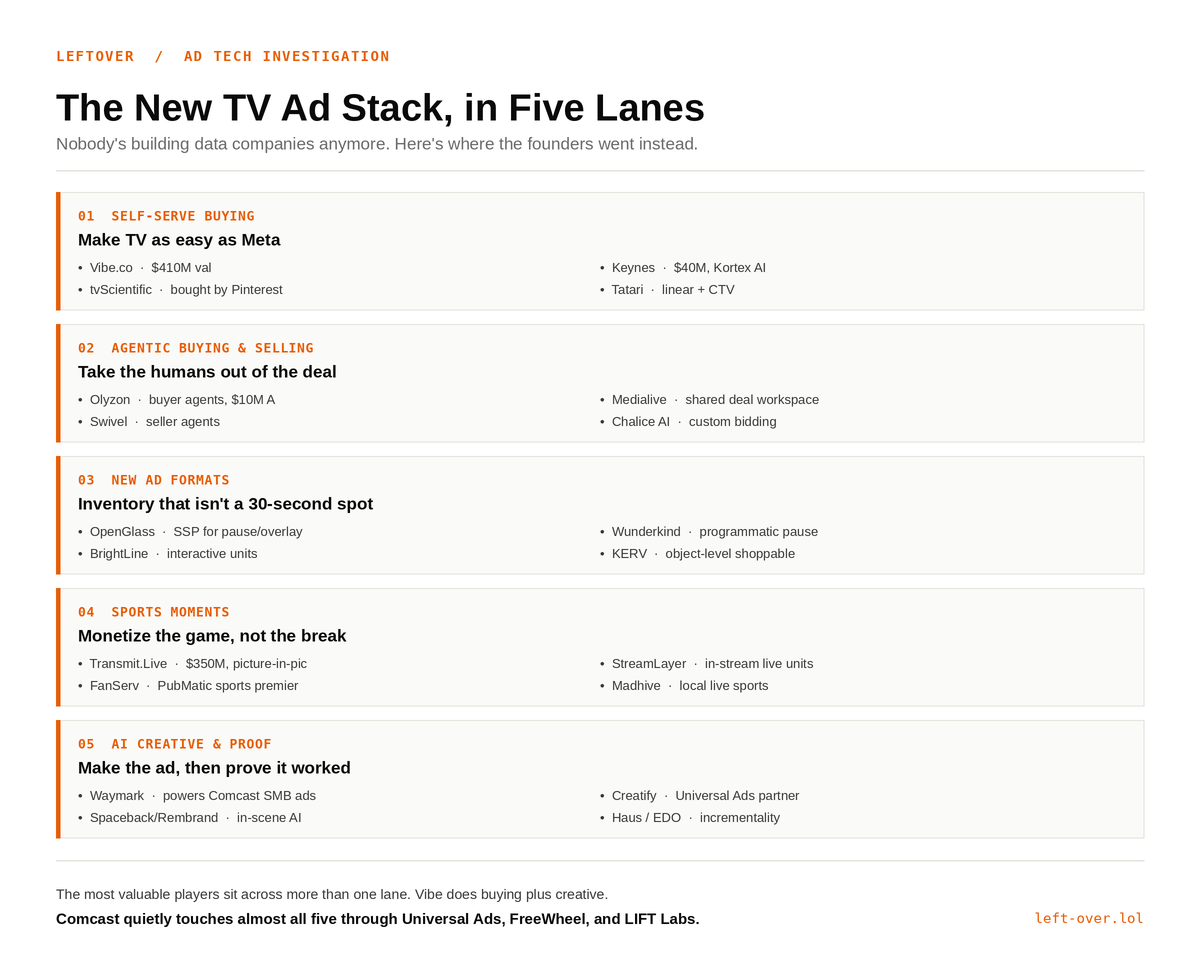
We pulled together every rising TV ad tech company we could find and looked for the pattern. It's clear. The new money and the new talent went into five specific lanes, all attacking the same target: the old way of buying TV, which still runs on 30-second spots and emails with spreadsheets attached. Here's the map.
Lane 1: Make TV as easy as Meta
The first wave is self-serve. The pitch is simple: buying a TV ad should feel like buying a Facebook ad, not like hiring an agency.
Vibe.co is the breakout. It raised $50 million last fall at a $410 million valuation and now lets a small business pick a streaming app, target an audience, and go live in five minutes. tvScientific built the same thing for performance marketers and got bought by Pinterest in December, which tells you the big platforms see this lane as a shortcut into TV. Keynes just raised $40 million to add an AI layer on top of the buying. And Tatari has been bridging old linear TV and new streaming for years.
The lane is crowded, and the broadcasters are now building their own versions. But the SMB market is so big and so underserved that there's room.
Lane 2: Take the humans out of the deal
This is the one I'd watch hardest. The second wave isn't making the old workflow easier. It's deleting it.
Olyzon and Swivel are building AI agents that buy and sell TV ads by talking to each other. Olyzon raised $10 million from Sir Martin Sorrell's fund to build the buyer-side brain. Swivel builds the seller side. They've already run live campaigns where a buyer robot and a seller robot negotiate the deal, with humans only stepping in at the checkpoints. Medialive and Chalice AI are circling the same idea from different angles.
The thesis here is brutal and probably correct: the single biggest cost in programmatic TV isn't the inventory, it's the people. Take them out and the math changes.
Lane 3: Inventory that isn't a 30-second spot
The third wave noticed that the most valuable real estate on your TV isn't the commercial break. It's the pause screen, the home screen, and the moment inside the show itself.
OpenGlass built an entire ad marketplace for these non-interruptive formats, and it's running pause ads across Paramount, Tubi, DirecTV, and more. Wunderkind is pushing programmatic pause ads with real attention measurement. BrightLine has been doing interactive TV ads for years and is finally getting its moment as the formats standardize. KERV uses AI to understand what's actually on screen, frame by frame, so an ad can attach to an object in the scene.
When you hit pause on a movie and an ad appears, that's a whole company. Several, actually.
Lane 4: Monetize the game, not the break
Sports is its own gold rush, because live sports is the last thing people watch in real time, and the ad breaks are limited.
Transmit.Live got a majority investment valuing it at $350 million for technology that drops picture-in-picture ads into the game itself, during breaks in play, not just the commercials. Its clients include AT&T, Ford, and Nike, plus the NHL and Paramount. FanServ built a sports-only marketplace and became the premier partner in PubMatic's AI live sports marketplace, with access to NBA, WNBA, MLB, and NHL inventory. StreamLayer puts interactive ads inside live streams triggered by what's happening in the game. Madhive is doing it at the local level.
The whole lane exists because of one fact: you can't fast-forward a live game, which makes those eyeballs the most valuable on television.
Lane 5: Make the ad, then prove it worked
The last wave handles the two ends nobody else wants: creating the commercial and proving it did something.
On creative, Waymark uses generative AI to turn a business's website into a TV-ready ad, and it powers Comcast's own small-business ad tool. Spaceback and Rembrand merged to put AI-generated creative directly into scenes and social-to-TV formats. Creatify does the same and partners with Comcast's Universal Ads. On the proof side, Haus and EDO measure whether a TV ad actually drove a sale, which is the question every CFO eventually asks.
The pattern under the pattern
Two things jump out once you lay it all on the table.
First, the most valuable companies don't stay in one lane. Vibe does buying and creative. PubMatic does selling and sports. The winners are the ones stitching two or three layers together, because a brand would rather have one partner than five.
Second, and this is the part nobody's saying out loud: look at how many of these roads run through Comcast. Waymark powers its small-business ads. Creatify and Spaceback partner with its Universal Ads platform. FanServ runs on its FreeWheel pipes. Waymark came up through its LIFT Labs accelerator.
That's the real story. The data layer got consolidated by agencies. The new ad tech layer is getting quietly organized by a cable company. And the founders, smart as ever, went exactly where the old money wasn't.