Legacy Media / Autopsy
The deal was supposed to create an American media juggernaut. Fifteen years later, Comcast is distributing cable network shares to shareholders and pivoting to broadband. The content bet didn't lose. It just stopped being the point.
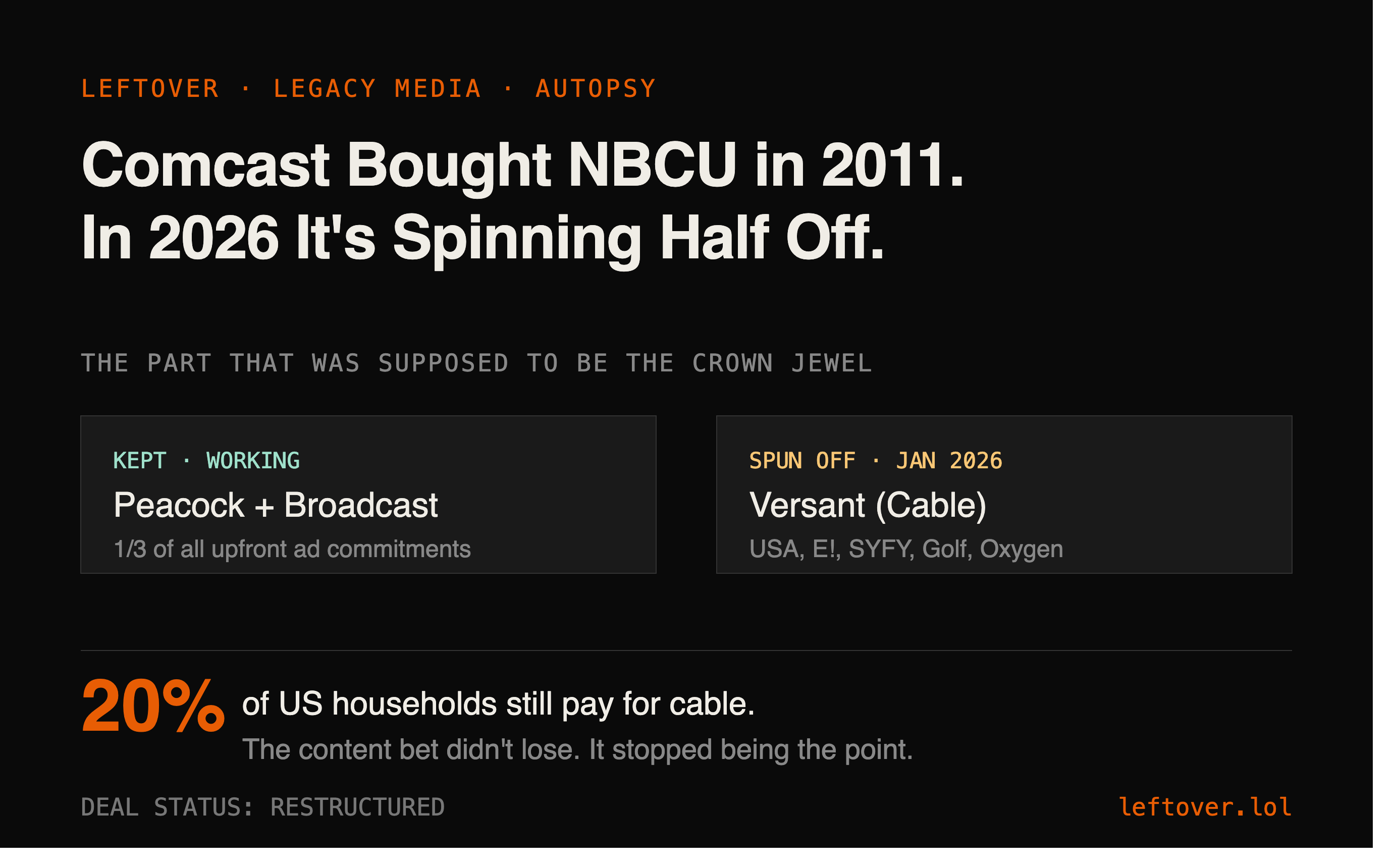
When Comcast closed its acquisition of NBCUniversal in 2011, first 51 percent, then the remainder by 2013, it was acquiring one of the most iconic media portfolios in American history. NBC. MSNBC. CNBC. Bravo. USA Network. Syfy. Universal Studios. Universal theme parks. The thesis was that owning distribution, Comcast's cable infrastructure, alongside content would create durable advantages as media shifted to digital.
Here is what actually happened. The theme parks made money. Peacock cost a fortune to build. Cable subscribers kept leaving. And the part of the portfolio that was supposed to generate growth, the cable networks, became the part Comcast is now spinning off entirely. The deal did not fail. The environment changed, and the portfolio that made sense in 2011 required a different structure in 2026.
In January 2026, Comcast completed the distribution of Versant, a new standalone company housing the NBCU cable networks except Bravo, to its shareholders. E!, Oxygen, USA Network, SYFY, Golf Channel. Gone from the balance sheet. Handed to investors who can now decide for themselves whether those assets have a future. Comcast retained Bravo because of its relationship with NBCUniversal's streaming and upfront strategy. Everything else was released.
The cable network portfolio that was supposed to be the crown jewel is now a separate company. Only 20 percent of US households still pay for cable.
Meanwhile, Peacock is quietly working. NBCUniversal wrapped its 2025-26 upfront with record ad sales volume, driven almost entirely by live sports. Super Bowl LX. The FIFA World Cup. The Milan Cortina Olympics. The return of NBA to NBC. Peacock accounted for one-third of total upfront ad commitments. That is not a struggling streaming service. That is a sports rights play starting to pay off fifteen years into a deal that looked expensive when it was signed.
The answer to the question of whether the Comcast-NBCU deal worked is not yes or no. The cable portfolio was worth buying in 2011 and is worth less now. The theme parks are worth more than anyone modeled. Peacock is a credible third streaming service built on the back of live sports. And Comcast, freed of its cable network obligations, is a broadband infrastructure company with a media business attached. That is not what the 2011 deal was supposed to produce. It might be exactly what 2026 requires.
Full interactive version: leftover.io/article/2 — left-over covers what happens after the press release.